


Endodontology is the field focused on the tissue inside the tooth or molar: the root canal. When this tissue is inflamed, a root canal treatment is needed, because the inflammation no longer heals on its own. An inflammation can also occur without you noticing it, which is why it is advisable to make an appointment with the dentist if in doubt. You can make an appointment by phone or by email.
- Experienced dentist specialising in endodontology
- Room for new patients right away
- Evening treatments possible
For information, please contact us on 030 760 1267 or info@tandartsutrecht.nl. New to our practice? Then simply register online.
More information about endodontology
Via the menu below you can find more information about endodontology and root canal treatments.
- When is a root canal treatment needed?
- A root canal treatment explained in photos
- An endodontic retreatment
- Endodontic surgery: apicoectomy
- Our dentist specialising in endodontology
- Costs and reimbursement
- More information about endodontology
When is a root canal treatment needed?
Below we explain step by step when a root canal treatment is needed.
- Every tooth or molar consists of a crown and a root. You can see the crown part in the mouth. The root is anchored in the jaw and sits below the gum. A tooth usually has one root, and a molar often has several roots.
- A canal runs through the root containing a blood-vessel-and-nerve bundle: the pulp.
- Due to tooth decay, a poorly fitting filling or a fracture in the tooth or molar, the pulp can become inflamed. This can be accompanied by pain, but it can also happen painlessly.
- As a result of the infection, the nerve dies and, over time, an inflammation develops in the jawbone around the root. We can usually see this clearly on an X-ray.
- To treat this problem, a root canal treatment is necessary.
- Under anaesthetic, the root canals are thoroughly cleaned and filled. Your dentist then checks the treatment with X-rays.
- Sometimes it is enough to seal the tooth or molar after the root canal treatment with a white filling, but it may also be necessary to restore the molar with an onlay or a porcelain crown for durable restoration of function.
The root canal treatment described in photos
Below you can see the progress of a root canal treatment in six photos.
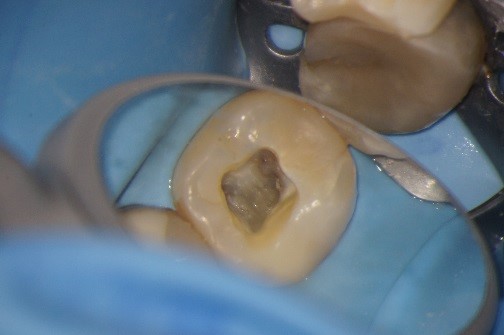
Photo 1: The molar is opened to make the root canal treatment possible.
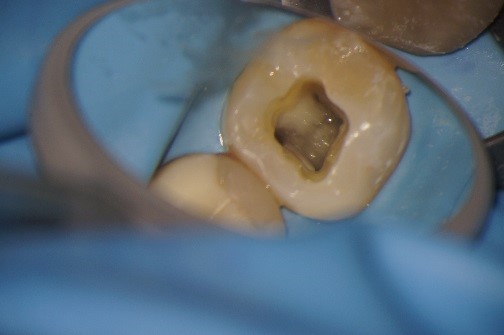
Photo 2: The root canals have been prepared and are ready to be rinsed out.
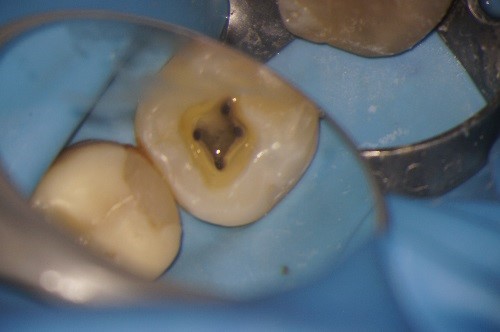
Photo 3: The root canals are rinsed out. This is the most important part of the root canal treatment.
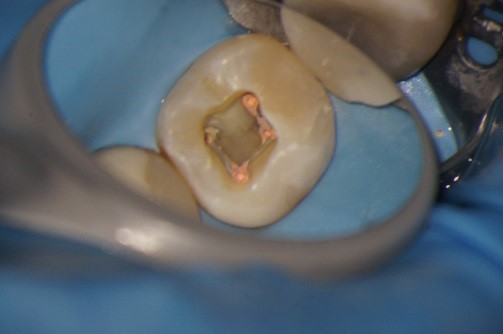
Photo 4: The root canals have been filled. The root canal treatment itself is finished. Only the filling remains.
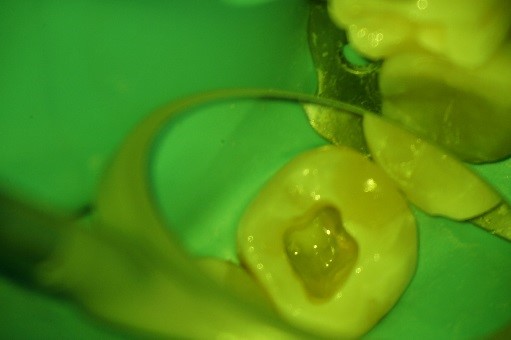
Photo 5: The filling is being made.
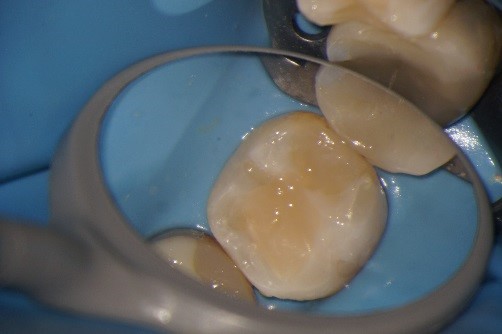
Photo 6: The filling has been made. The molar is ready for use again.
The endodontic retreatment
It may be necessary to carry out a root canal treatment again; in that case we speak of an endodontic retreatment. A root canal treatment that was carried out in the past can be improved with current insights and techniques in order to preserve the molar. The retreatment proceeds as follows:
- Anaesthetising and opening the molar
- Removing the existing canal filling
- Thoroughly cleaning and filling the root canals
- Checking the treatment with X-rays
After the root canal treatment, we determine for each tooth or molar what the best restoration is. This can be a permanent filling, but also a porcelain crown or onlay.
Endodontic surgery: apicoectomy
Instead of an endodontic retreatment, it may also be necessary to carry out an apicoectomy, known as endodontic (micro) surgery. With an apicoectomy:
- We preserve the existing root canal treatment. Through the gum, we create access to the root tip and the surrounding jawbone.
- We remove the inflamed tissue and clean and fill the root tip.
- Finally, we close the gum again with a few stitches.
Often there is an appointment with the dentist after a few days to check the healing.
Our dentist specialising in endodontology
Christiaan Goosen (BIG: 69915736102) is the dentist at Maliekwartier Tandartsen. His special areas of interest are reconstructive dentistry and endodontology. Please contact us to make an appointment for a personal consultation.
“I am very satisfied with the dentists at this dental practice. Dentist Goosen is highly competent and professional, but also pleasant and friendly. He also gives clear explanations before, during and after the treatment. I have had good experiences with the root canal treatment. In short, a pleasant team and a practice with a good atmosphere.” A. Klein Brink on Google
Costs and reimbursement of root canal treatments
The rates for root canal treatments, retreatments and endodontic surgery are set by the Dutch Healthcare Authority (NZa). The cost of the actual treatment is determined partly on the basis of the number of root canals to be treated. Based on a preliminary examination, the dentist will give you a cost estimate before the treatment.
Reimbursement
For people up to the age of 18, root canal treatments are reimbursed under the basic health insurance. When you are 18 years or older, you must have supplementary insurance for endodontology. With supplementary insurance, the treatment is in many cases (partly) reimbursed. We therefore recommend consulting the policy conditions of your health insurer before the treatment.
More information about our rates >>
More information about endodontology
Would you like to know more about endodontic treatments? Then please contact us by phone on 030 760 1267.
For more information from the Ivoren Kruis about the root canal treatment, click here.
The Dutch Association for Endodontology (NVVE) also has a digital leaflet: click here or view the leaflets below:
Make an appointment or register
Would you like to make an appointment for a dental check-up? Please contact us via 030 760 1267, info@tandartsutrecht.nl or register as a new patient at our practice in Utrecht..
Frequently asked questions about the root canal treatment
How painful is a root canal treatment?
A root canal treatment is carried out under local anaesthetic. As a result, you usually feel no pain during the treatment, although you may experience pressure or movement. After the treatment, the tooth or molar can remain sensitive for a few days, for example when chewing or biting. This is a normal reaction of the body and usually disappears on its own.
How long does a root canal treatment take on average?
The duration of a root canal treatment depends on the tooth or molar and the complexity of the treatment:
- For a front tooth or canine, which usually has one root canal, the treatment often takes around 30 to 60 minutes.
- For a molar with several root canals, the treatment can take longer, usually between 60 and 90 minutes and sometimes up to about two hours.
In some situations, the treatment is divided over two appointments, for example when there is an extensive inflammation or when more time is needed to treat the tooth carefully.
Why does a root canal treatment sometimes take two appointments?
Sometimes a root canal treatment is divided over two appointments. This can be necessary when the inflammation is severe, when there are several root canals, or when the dentist needs extra time to clean and disinfect the canals properly.
During a following appointment, the tooth is permanently sealed and restored. In some situations, this approach is needed to carry out the treatment as carefully as possible.
What happens if I postpone a root canal treatment?
If you postpone a root canal treatment, the inflammation in the tooth or molar can get worse. The bacteria can spread further into the jawbone and the surrounding tissue. This can lead to more pain and, in some cases, to swelling or an abscess.
Sometimes the nerve in the tooth dies, which makes the complaints seem to decrease temporarily, while the infection is actually spreading further. If an inflammation is left untreated for too long, there is a risk that the tooth or molar can ultimately no longer be saved and may have to be removed.
How long does recovery from a root canal treatment take?
After a root canal treatment, it is normal to experience some sensitivity or after-pain for a few days. These complaints usually subside within a few days and are often gone within a week. In some cases, mild sensitivity can last a little longer, but most people feel back to normal quickly.
Can I work after a root canal treatment?
In most cases, you can simply work after a root canal treatment, as long as you feel fit enough for it. The anaesthetic can last for another one to three hours, which can make talking or eating temporarily a little more difficult.
The treated tooth or molar can be sensitive for the first few days. With a painkiller such as paracetamol or ibuprofen (if you are allowed to use these), working usually goes fine. If your work involves a lot of talking or heavy physical labour, it can be pleasant to take it a little easier that day.
When can I eat normally again after a root canal treatment?
You can usually eat again as soon as the anaesthetic has completely worn off, usually after about one to three hours. It is sensible to wait with eating and hot drinks until the anaesthetic has gone, so that you do not accidentally bite your cheek or lip.
On the first day, it is pleasant to choose soft, lukewarm food and to avoid hard or sticky products, such as nuts, crisps or baguette. Especially when a temporary filling has been placed, it is sensible not to put too much strain on the treated tooth yet. From the next day, you can usually eat normally again, as long as you take any sensitivity into account.
What should you avoid after a root canal treatment?
Directly after the treatment, it is sensible to wait with eating and drinking until the anaesthetic has worn off. This prevents you from accidentally biting your cheek or lip. In addition, it is often advised not to put too much strain on the treated tooth temporarily and to avoid hard or sticky food until the tooth has recovered well.
Can a tooth discolour after a root canal treatment?
Yes, a tooth can discolour after a root canal treatment, but this happens less often nowadays than in the past. After the treatment, the tooth is no longer vital, and remnants of blood or nerve tissue can seep into the dentine, which sometimes gives a grey or bluish discolouration, especially in front teeth.
Thanks to modern treatment techniques and materials, we fortunately see this discolouration less and less. Should a visible discolouration nevertheless occur, our dentist can often correct it. For example, with an internal bleaching treatment or, if necessary, with a veneer or crown.
Is a root canal treatment covered by insurance?
Whether a root canal treatment is reimbursed depends on your age and your health insurance.
- Up to 18 years: the basic health insurance reimburses the full treatment. You do not pay any excess for this.
- 18+: for adults aged 18 and over, a root canal treatment usually does not fall under the basic health insurance. In that case, supplementary dental insurance is needed for reimbursement. Many supplementary policies reimburse part of the costs, often around 70 to 80 percent, up to an annual maximum amount.
Contact
Maliekwartier Tandartsen
Koningslaan 62
3583 GP Utrecht
Opening hours
Monday: 08:00 am – 08:00 pm
Tuesday: 08:00 am – 08:00 pm
Wednesday: 08:00 am – 08:00 pm
Thursday: 08:00 am – 08:00 pm
Friday: 08:00 am – 04:00 pm
Weekend: Closed